
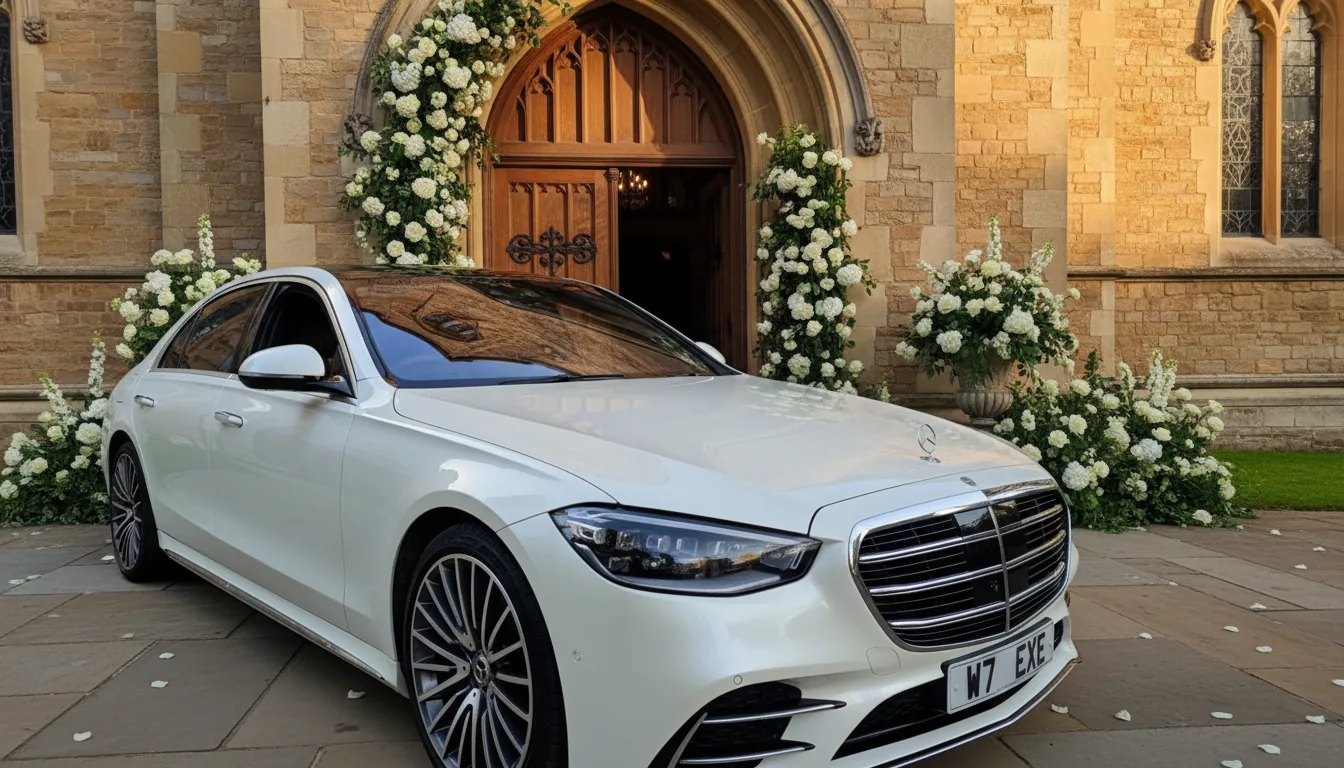
The traditional pattern
Most British weddings follow a familiar shape. On the way to the ceremony, the bride rides in the main car with her father, mother or whoever is walking her down the aisle. She is the last to leave the house and the last to arrive, so that her entrance is the moment everyone is waiting for. After the ceremony, the married couple ride together in the same car to the reception, often with a pause for photographs.
Those two journeys are the heart of the booking. Knowing who is in them tells you which car to choose and when the other passengers need to travel.
Bridesmaids and the bride's mother
Bridesmaids, flower girls and the bride's mother usually leave the house first, so they are at the ceremony and ready before the bride arrives. With a large bridal party that means a second vehicle. The seven-seat Mercedes V-Class is designed for exactly this: captain's chairs keep dresses from creasing and the sliding doors make getting out graceful.
In some weddings the main car makes two trips instead, taking the bridesmaids first and returning for the bride. That can work when the ceremony is close, but it tightens the timings; a second car is the calmer option.
The groom and best man
The groom and best man traditionally arrive well before everyone else, often making their own way. Some couples like the groom to arrive in style too, and the Mercedes S-Class is a favourite for that journey. Because he needs to be at the ceremony so early, his car can often be scheduled before the bride's collection.
Parents and grandparents
Parents of the couple and grandparents are often the people who most appreciate being driven. A car for them removes worry about parking and means they arrive relaxed. The Audi A6 or S-Class suits two or three passengers; the V-Class can bring a larger family group. Chauffeurs help older relatives in and out and make sure walking aids travel with them.
After the ceremony
Once the couple leave for the reception, the bridal party and family generally follow, either in the second car or with guests. If you want your parents or the bridesmaids to reach the reception before you, for a receiving line or photographs, tell us and the order will be planned that way.
Modern and cultural variations
Plenty of couples do things differently: arriving together, walking in with both parents, or choosing a friend to share the journey. At Asian weddings, the doli car carries the bride from her family home, while the baraat has its own significance for the groom's side. There is no wrong answer; the plan simply follows whoever is travelling.
Putting your plan together
Remember the little details too: a car seat for a young page boy, space for a grandparent's wheelchair folded in the boot, or a bouquet that needs to travel flat. Mention them when you enquire and the right car can be matched to each journey, rather than discovering a problem on the morning itself when there is no time left to change anything. List every journey on the day with who is in it, where from and roughly when. That list tells us how many cars you need and which ones fit. Send it with your enquiry or call 07977 407474 between 07:00 and 23:00 for a fixed quote covering every car in the plan.